
You drop to your knees after stalling on a floor push-up. The starting position feels manageable. Then you bend your elbows, get closer to the floor, and hit the part of the rep where it’s harder to push back up. A force-plate test gives you a way to see how the load changes as you get lower.
In one lab study, the hands supported about 54% of body weight at the top of a knee push-up and 62% at the bottom. Keeping your knees down reduced the load at both points compared with a full push-up.
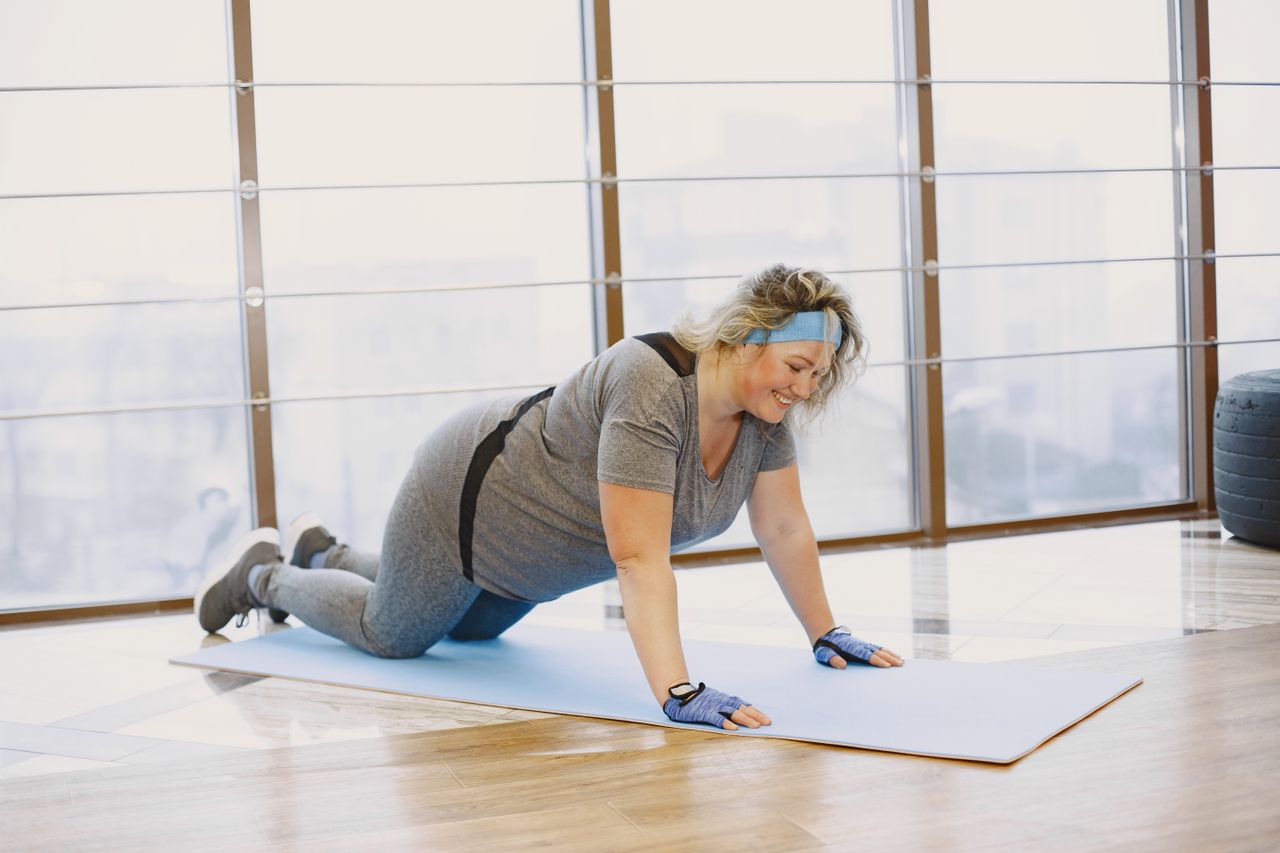
Table of contents
What the force plate picked up
In the study by David Suprak and colleagues, 28 strength-trained men put both hands on a force plate. They held four positions for six seconds at a time. In the high position their arms were straight. In the low position their elbows were bent to about 90 degrees. They did both holds with their knees down and with their toes supporting them.
In the full push-up, the hands supported about 69% of body weight at the top and 75% at the bottom. The knee-down version went from about 54% to 62%, a difference of about 8 percentage points. Even the bottom of the knee version put less weight through the hands, on average, than the top of the full version.
The plate recorded the vertical force through both hands during each hold. That measurement doesn’t say how much work your chest or triceps did individually. The participants held each position still, so the figures describe two points in a particular setup. A moving repetition can put different forces through your hands.
Try a version you can lower and press back up
The American Council on Exercise’s knee push-up guide starts with the shoulders over the hands and a straight line from shoulders to knees. Keep that shape as the elbows bend. If your hips fold or your lower back sags on the way down, stop a little higher on the next rep and see whether you can press back up smoothly.
Use a depth you can repeat without dropping into the bottom. Once you can lower and press back up at that depth, try going a little farther on the next set. Keep your hand placement and knee position the same so you can tell what changing the depth did.
Use a higher hand support if you want more room to lower
In a separate force-plate study of 23 recreationally fit adults, researchers measured peak force during moving repetitions. A push-up with the hands on a 24-inch box produced less peak force than the knee-down version in that test. At 12 inches, the hand-elevated version produced more force than the knee version, while still coming in below the full floor push-up. These are separate measurements from the six-second holds.
If your knee-down rep stops short, you can try a stable raised surface and see whether it lets you lower farther under control. A wall is another option. Our wall push-up progression shows how you can change the angle with your feet before moving to a lower support.