
You cannot yet lift your whole body on dip bars, so a bench looks like the obvious step back. Your feet stay on the floor, your hands sit behind you, and the repetition feels more manageable. Before treating it as the same exercise made easier, look at the shoulder position.
A small motion-analysis study found greater shoulder extension during bench dips than bar dips. Foot support and shoulder movement are separate considerations, rather than one difficulty setting.
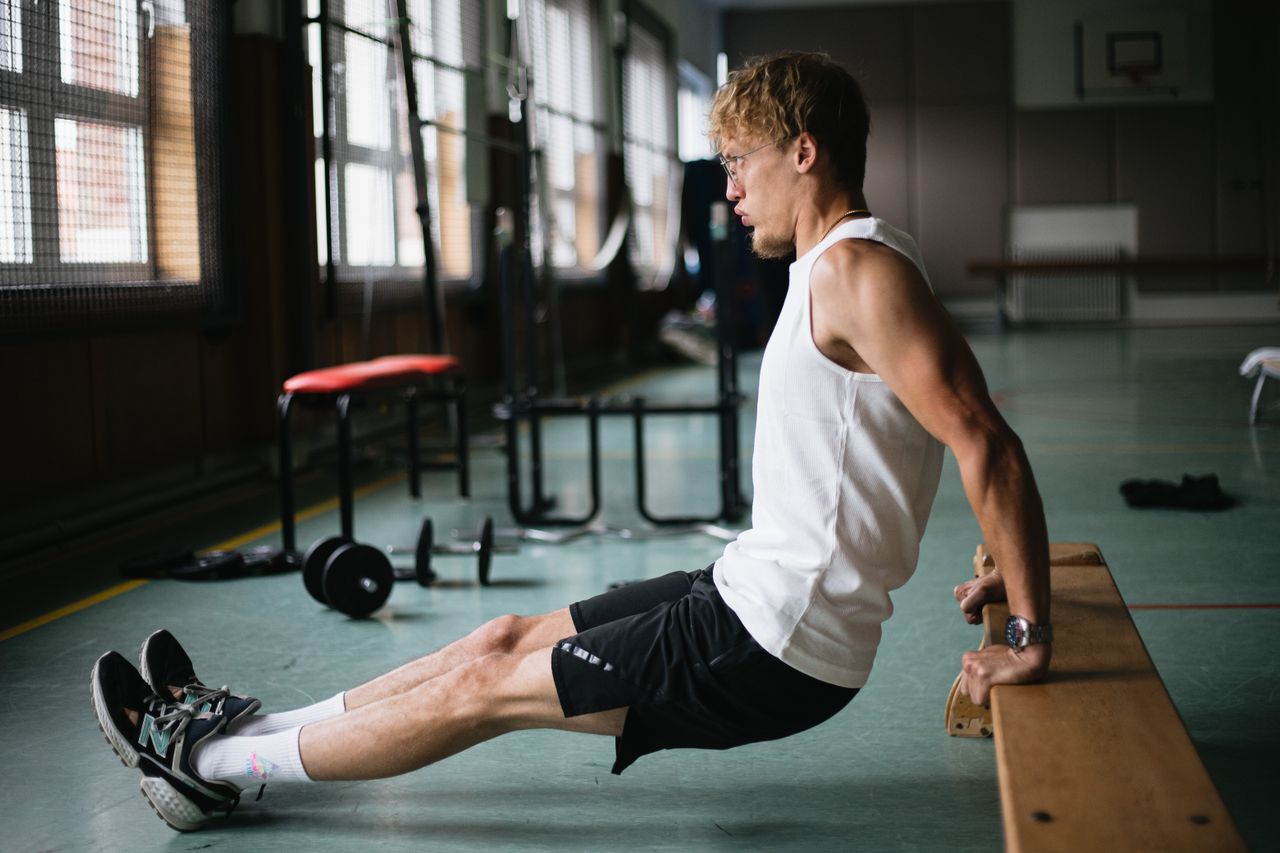
Table of contents
Less muscle activity did not mean less shoulder range
The 2022 comparison recruited 13 experienced men for bench and bar dips; 11 also completed ring dips. They performed four repetitions of each tested variation, choosing their own technique and range.
Bench dips produced greater peak shoulder extension—the upper arm’s backward movement—than bar dips, despite lower peak triceps activation.
This was a small, low-repetition laboratory comparison using bodyweight and a V-shaped bar. It did not follow injuries or measure months of muscle growth, and it does not establish that bench dips injure everyone or that bar dips suit everyone.
An elbow cue does not describe the whole position
Health and Wellbeing Queensland’s exercise instructions describe a bench dip with the knees bent, hips lifted off the support, and elbows bending to about 90 degrees before pressing up. That is one published version, rather than an individualized range prescription.
The elbow angle describes how much the forearm bends relative to the upper arm. Shoulder extension describes the upper arm relative to the torso. Checking one angle does not tell you the other, which is why “my elbows reached 90 degrees” does not fully describe the repetition.
If you ask a coach to review the exercise, show the bench position, hands, torso and feet together. A close-up of the elbow leaves out the rest of that arrangement. The useful review concerns the whole movement, not matching a single still photograph.
Choose the goal before choosing the substitute
In its professional discussion of bench dips, the American Council on Exercise cautions against interpreting an activation ranking as a universal effectiveness verdict. Its earlier experiment could not match the bodyweight exercises’ resistance to the percentage-based loads used in other exercises.
ACE also advises weighing the individual’s circumstances and considering alternatives. A movement producing a strong triceps signal does not, by itself, answer whether that movement is the right choice for a particular person.
Tell your coach whether you want general triceps work or a progression toward bar dips. Those goals can call for different choices; a bench is not automatically the next required stage simply because it is available.
If you choose push-ups for bodyweight pressing, our standard-versus-diamond push-up comparison explains why a more demanding-looking variation should not be selected from an activation claim alone. Decide what you need the exercise to do, then assess the actual movement.