
You lower into a bodyweight squat, notice your knees approaching your toes, and push your hips farther back to keep them behind that imaginary line. Soon you are leaning forward and concentrating on your feet instead of the movement. A rule intended to simplify the squat can end up giving you only one detail to watch.
Orthopedic surgeon James Ware, MD, explains that some forward knee travel can be normal. His more useful checks are control, balance, knee alignment and a range that is appropriate for the individual—not whether the knee crosses one fixed line.
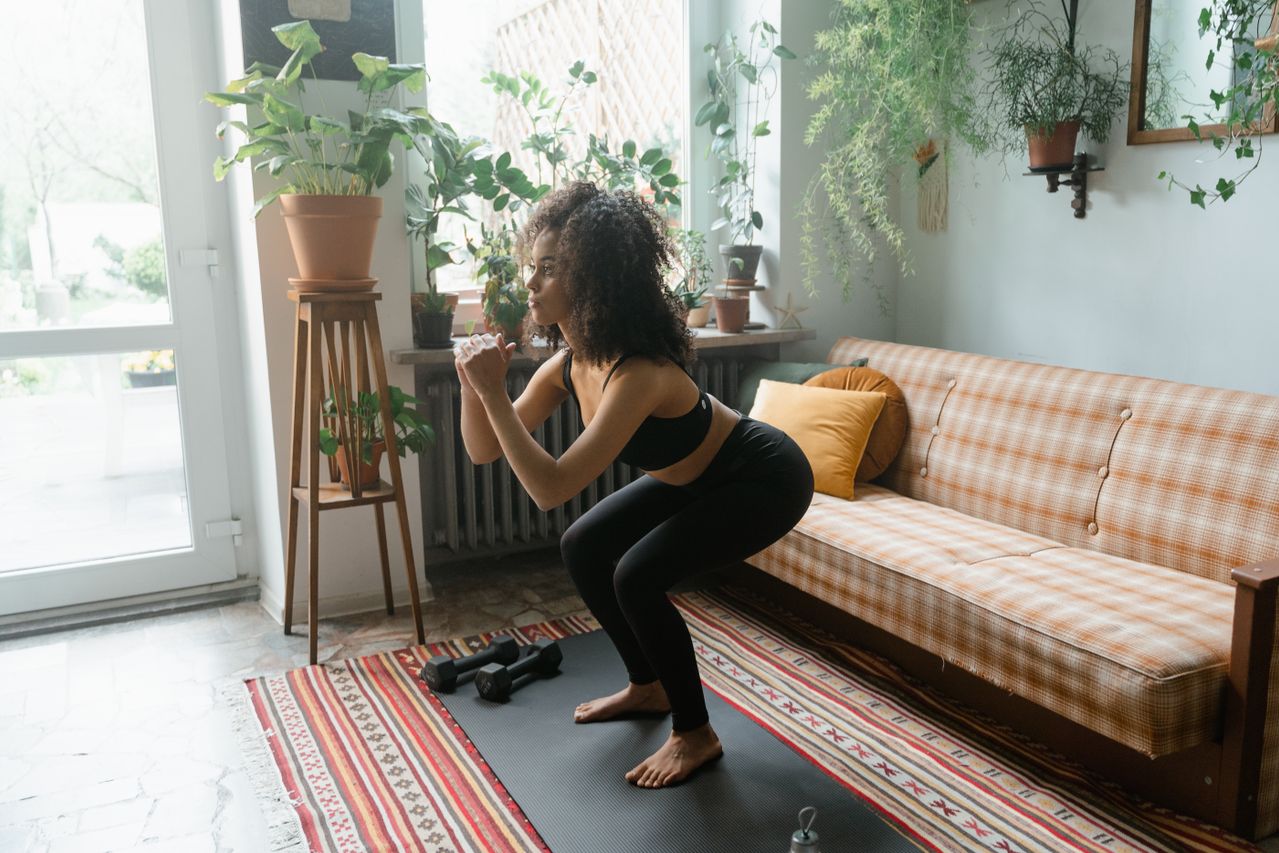
Table of contents
Restricting knee travel changes the rest of the squat
A 2003 study by Andrew Fry and colleagues examined seven weight-trained men performing parallel barbell squats. The barbell load equaled each participant’s body weight. In one condition, a wooden barrier kept the knees from moving beyond the toes; in the other, the knees could travel forward.
Restricting that movement reduced the calculated knee torque but increased hip torque. Torque describes rotational demand around a joint. The restricted version also changed the lifters’ positions, including greater forward trunk lean. Holding one joint back did not simply remove the task’s demands.
The important limit is the experiment itself: this was a small study of trained men doing loaded squats, not a trial of injuries, rehabilitation or bodyweight squats in every age group. It illustrates a mechanical trade-off; it cannot establish one universally safe knee position.
Watch your whole foot and knee direction
The ACE bodyweight-squat instructions allow the knees to begin moving forward as the hips lower, while asking the exerciser to control that motion. The guidance also tracks the feet, ankles and torso, rather than treating knee travel as the entire exercise.
Its checkpoints include keeping the heels down, the feet stable and the knees aligned with the second toe. Viewed from the front, knee direction is a separate question from how far the knees move forward when viewed from the side.
ACE describes distributing body weight between the balls and heels of the feet in the lowered position. If stopping the knees at the toes makes you lose that balance, look at the whole position with a coach instead of trying harder to obey the line.
Likewise, heels lifting or the torso rounding can mark the end of the controlled range for that attempt. Our guide to factors that can limit squat depth explores why depth also involves mobility, stance and practice, rather than a single knee cue.
A knee-specific limit can still be useful
In his Hartford HealthCare explanation, Ware notes that greater forward movement can increase stress around the front of the knee. Someone with knee pain, arthritis or an injury may find a modified range more comfortable. That individual use is different from applying a restriction to everyone.
For healthy knees, his advice emphasizes controlled movement, knees following the toes’ direction and a pain-free range. Crossing the toes is not automatically an error, but it is not a target you need to force either.
If a squat repeatedly hurts, adjust the movement rather than pushing through to prove a technique point. Ware describes changes such as reducing depth or using support, with the choice depending on the person. A doctor or physical therapist can assess pain or an existing knee problem.