
You finish a set of kettlebell swings and your shoulders feel as if you have been doing front raises. The bell reached the height you wanted, but you had to heave it there with your arms. Before adding more weight or repetitions, look at where the upward movement is coming from.
ACE identifies lifting the bell with the arms and shoulders as a technique mistake in the hip-hinge swing it teaches. Its correction is to generate momentum with hip extension, allowing the bell to rise instead of front-raising it.
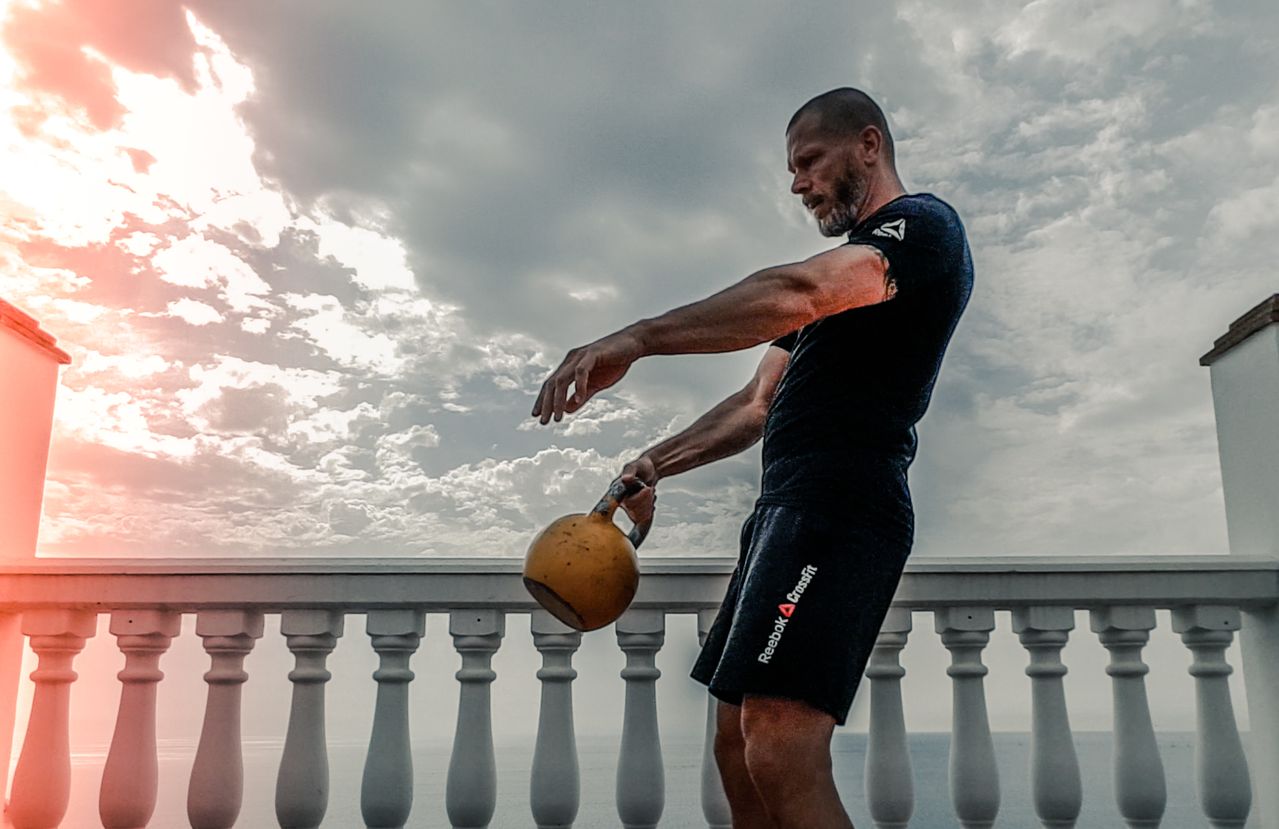
Table of contents
Make the hips the starting point
In ACE’s January 2025 coaching feature, exercise specialist Pete McCall, CSCS, describes a swing powered by the lower body. The hips move back during the hinge and then extend forcefully to send the kettlebell forward and upward.
The version he explains uses a slight knee bend and relatively upright shins. That distinguishes its backward-and-forward hip movement from dropping into a squat and standing up. The spine stays long as the torso tips because the hips are bending.
CrossFit’s movement explanation uses the same core-to-extremity principle: the hips and legs produce force, which passes through the arms to the bell. A stable midline is part of transferring that force. The visible height of the weight is only the endpoint; it does not reveal how you produced the movement.
Your arms still have a job
“Do not front-raise it” does not mean letting your upper body go loose. You still have to hold and guide the kettlebell while maintaining your position.
In an excerpt from Michael Hartle’s Kettlebell Strength Training Anatomy, the two-handed swing uses the abdominal muscles and lats to help stabilize the spine while the glutes and hamstrings produce hip extension. The grip and upper-body tension remain active.
Hartle describes standing fully upright with the abdominal and gluteal muscles engaged as the bell rises to approximately chest level. He also warns against overextending the spine. Finishing the hip movement is different from leaning backward to make the bell appear higher.
On the descent, his instruction is to keep the upright position until the bell approaches, then move into the hinge as it travels back between the legs. The return is part of the technique, rather than an invitation to let the weight pull you out of position.
Agree on the endpoint before counting reps
ACE’s demonstration brings the bell to chest or shoulder height. A CrossFit workout may specify a different endpoint: its official FAQ describes a directly overhead, or American, swing as the default unless flexibility or the workout’s instructions call for something else.
Those are not interchangeable standards for counting repetitions. Check which swing your coach has prescribed. The shared hip-driven start does not erase the extra overhead position required by one version.
Then choose a bell that lets you practice the requested movement. If a conditioning workout falls apart because every repetition needs an arm heave or a long reset, our guide to matching an Rx load to the workout’s intended pace explains why lifting the weight once is an incomplete test.
If the hinge itself is unfamiliar, ACE recommends learning it before progressing to ballistic swings. Have the coach check a controlled loaded hinge first, rather than trying to solve the movement by yanking the bell higher.