
You prop yourself up on one forearm, straighten your legs, and lift your hips. A few seconds into the side plank, your bottom hip starts sinking toward the mat. Before you try to hold that position longer, bend your knees and set the lower knee down. That moves the support at the far end of the plank closer to your hips.
The knee-supported version gives you a shorter span to hold steady. In a small lab study, people rated it easier on average, and the external oblique at the side of the abdomen registered less activity than it did with the legs straight.
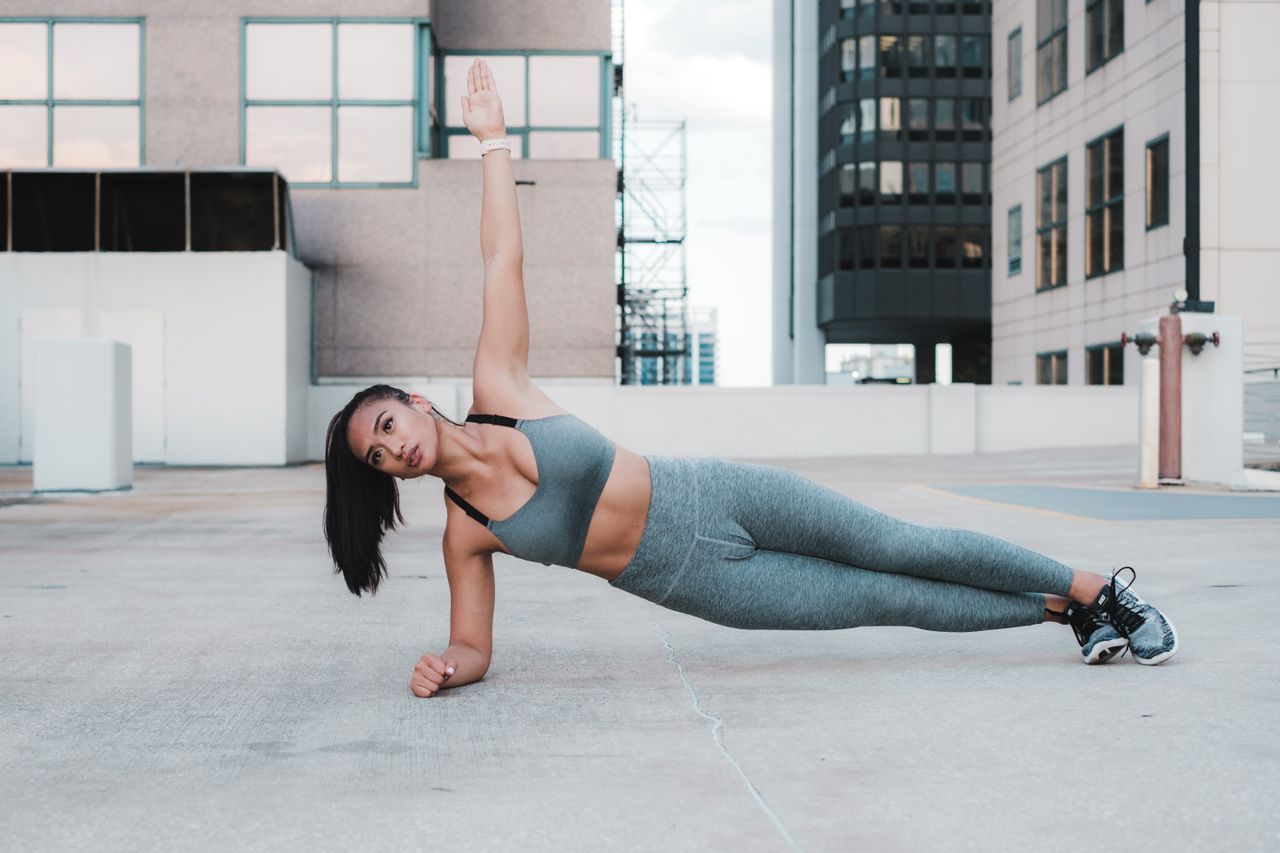
Table of contents
The floor meets your body at a different point
In a full forearm side plank, your forearm and the edge of your lower foot support you. With your knees bent, the lower knee becomes the support at the other end. The knee sits closer to your hips than your foot does, so the distance between your forearm and the lower support gets shorter. The Ohio State sports medicine team demonstrates that progression from bent knees to stacked feet.
Rafael Escamilla and colleagues tested both versions in 18 adults. Each person did five reps of each exercise, with a one-second lift, one-second hold, and one-second lower. The average signal in the external oblique, a muscle along the side of the abdomen, was 37% of the signal from a separate maximum-effort contraction with the knees down and 62% with the feet down.
The signal describes muscle activity during those short repetitions. The researchers didn’t measure how much strength either version builds over weeks or tell participants how long to hold a plank at home. You can use the easier position to practice keeping your hips up while you breathe.
Keep the shoulder and hips in the same setup
Lie on your side with your knees bent and stacked and your feet behind you. Put your bottom elbow under your shoulder, with your forearm on the mat. Press into that forearm and lower knee to lift your hips until your shoulders, hips, and knees make a straight line. Keep your top hip directly above your bottom hip as you breathe.
Watch for the first change you’re trying to avoid. If your hips start dropping or your top hip rolls backward, lower to the mat and reset. A mirror or a short phone clip can help you see when that happens. Repeat on the other side and check the position there too.
Try a shorter hold on your feet
When the bent-knee version feels steady on both sides, try a short hold with straight legs. The National Academy of Sports Medicine’s instructions keep the elbow under the shoulder and allow either stacked or staggered feet. If stacking them makes you wobble, try placing one foot slightly in front of the other while keeping your hips lifted.
If you track time, write down where your lower support was. The same idea applies in a front plank when the elbows move. Compare knees-down holds with other knees-down holds, and let the first steady hold on your feet set a new starting time.