
You have a little space beside a wall, but no weights, bench or exercise mat. That still leaves several useful choices: pushing against it, holding a seated position, moving your arms along it or using it for balance support. The wall does a different job in each exercise.
These four options combine an upright push, a static leg hold, shoulder movement and balance practice. Choose the task you need; this is a selection of movements, rather than a complete strength program.
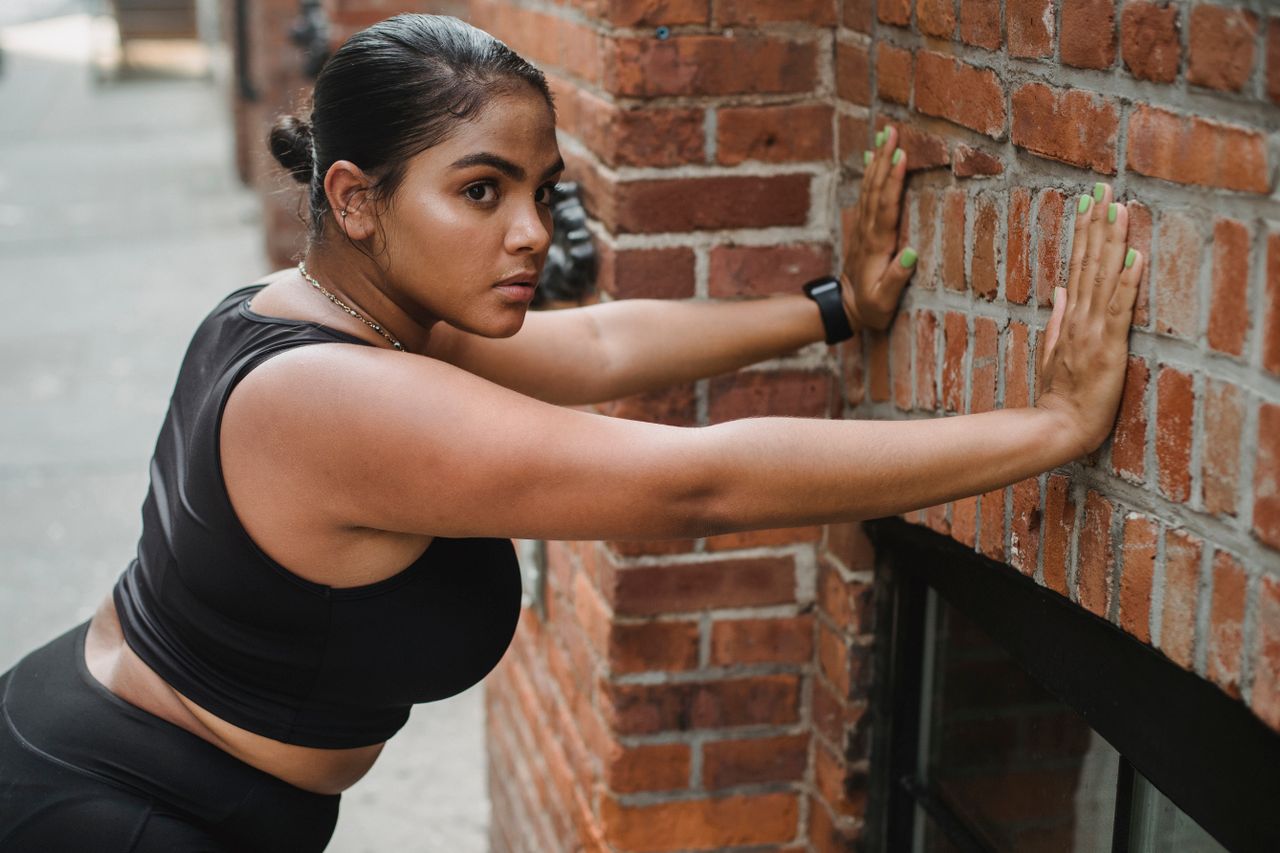
Table of contents
1. Wall push-up: an upright pushing exercise
Face the wall for this one. The NHS wall press-up instructions begin at arm’s length, with palms against the wall at chest level and fingers pointing up. Keep your back straight as you slowly bend your elbows beside your body, bringing yourself toward the wall. Press back to the starting position without rushing.
This choice gives you a pushing movement while you stay on your feet. If you already do it comfortably, our guide to adjusting your wall-push-up stance explains a way to change the challenge before attempting floor repetitions.
2. Wall sit: a leg exercise you hold
Turn around and place your back against a stable wall. Walk your feet forward, then bend your knees while sliding down into a position you can hold. Unlike the push-up, this is an isometric exercise: the working position stays still.
Physical therapist Rebecca Justen, DPT, explains in Cleveland Clinic’s wall-sit guide that beginners can start with a shallow sit. You don’t have to reach a deep, chair-height position or hold for a full minute. Choose a brief hold that matches your ability. To come out, bring one foot back toward the wall and slide up to standing.
3. Wall angel: controlled shoulder movement
This time, use the wall as a guide while your arms move. Cleveland Clinic’s instructions start with your back against the wall, arms by your sides and palms facing out. Slowly slide your arms outward and upward, then lower them, keeping the backs of your hands against the wall and your body position steady.
Reaching overhead isn’t compulsory. HSS physical therapist Hannah Solomon, PT, DPT, COMT, recommends using a smaller, comfortable range if needed, including keeping the elbows below shoulder height. Don’t force a painful movement to copy a larger arm arc. Here, the useful task is moving within a range you can manage.
4. Supported single-leg balance: keep help within reach
The American Heart Association includes standing on one foot among its balance exercises. If that is challenging, its suggested progression begins with both hands on a wall or sturdy chair. That makes the wall a support you can use while practicing the standing task.
Hold the wall, lift one foot and practice on each side with the support you need. The AHA describes moving from two hands to one hand, then a finger, and eventually no support when steady. There is no need to skip those stages or turn the exercise into an unsupported endurance test.
If you think you may be at risk of falling, the AHA advises talking with a health professional. Choose the support before lifting your foot.