
You reach one arm forward and the opposite leg behind you, then try to lift that leg a little higher. The bird dog looks bigger, but your lower back starts dipping and one hip turns upward. The extra height has changed more than the position of your foot: the trunk you meant to control is moving, too.
ACE’s bird-dog instructions make back control the boundary for the reach. Raise the arm and leg only as far as you can maintain the lower-back position, rather than treating the highest possible foot as the target.
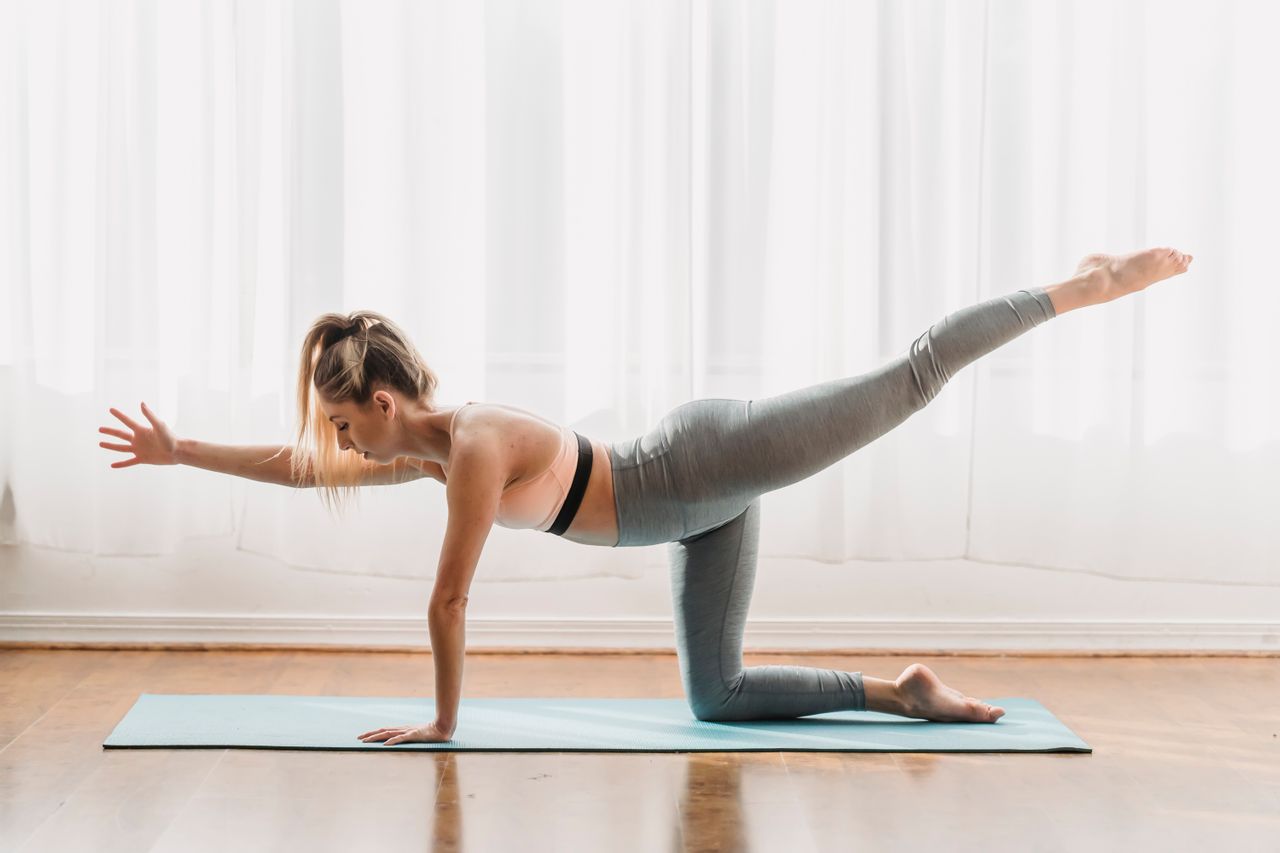
Table of contents
Let your trunk set the limit
The photo shows a raised-leg yoga variation. For this control-focused bird dog, use your steady trunk to set the limit rather than copying that height.
The American Council on Exercise starts the movement on hands and knees, with hands beneath shoulders and knees beneath hips. Engage the abdominal muscles, keep the spine neutral, and extend an arm with the opposite leg.
The intended direction is outward toward a position near parallel with the floor. ACE specifically says that how far you lift depends on controlling movement in the lower back. If the back begins to sag as the leg rises, the added reach has exceeded that boundary.
Watch the pelvis as well as the foot. Keep the two hips level instead of rotating the lifted-leg side toward the ceiling. A foot can travel higher because the pelvis turns, even when that is not the movement you intended to practice.
Practice one limb before combining the pair
Mayo Clinic’s quadruped instructions, another name for the bird dog, offer a simpler way to begin. Raise and lower one arm, repeat on the other side, then practice each leg separately. Lifting an opposite arm and leg together is its added challenge.
That leaves three points of support while one limb moves. Use the simpler version to notice whether the back and hips keep their position, rather than forcing the paired version immediately. Lowering the moving limb and resetting is more useful than continuing to reach after the torso has started to shift.
Mayo’s version includes a hold for three deep breaths. Treat that as part of its instructions, rather than a reason to stay up while the position changes. Continue breathing normally; a longer hold and a controlled hold are different things to assess.
Check the position instead of chasing the picture
In an August 2026 Harvard Health article, physical therapist Mary Kate Miller flags lifting the limbs above the trunk, turning the hips, looking upward and favoring speed over control. The written setup preserves the spine’s slight natural curves; it does not ask you to force your back completely flat.
Miller suggests a mirror for feedback and a small pillow on the back as a cue to unwanted movement. A coach can also watch while you reach, so you are not lifting your head and twisting around to inspect yourself.
Once the one-limb version is controlled, combining the opposite arm and leg gives you a clear next step. If your routine also includes planks, our guide to deliberate changes in plank position explains another progression to assess separately. A harder variation is a choice, not a reason to abandon the position you intended.
For the next bird dog, finish the reach where the trunk can stay steady. The height of the foot is only useful alongside that check.