
Your usual forearm plank is getting easier, and the obvious next target is more time. But the position you hold matters alongside the seconds you count. Researchers tested that distinction by keeping each hold at 30 seconds while changing how participants supported their bodies, including where they placed their elbows.
Moving the elbows farther forward and closer together increased electrical activity in some abdominal muscles compared with a standard plank. The finding offers a different way to think about progression, with important limits on what that measurement proves.
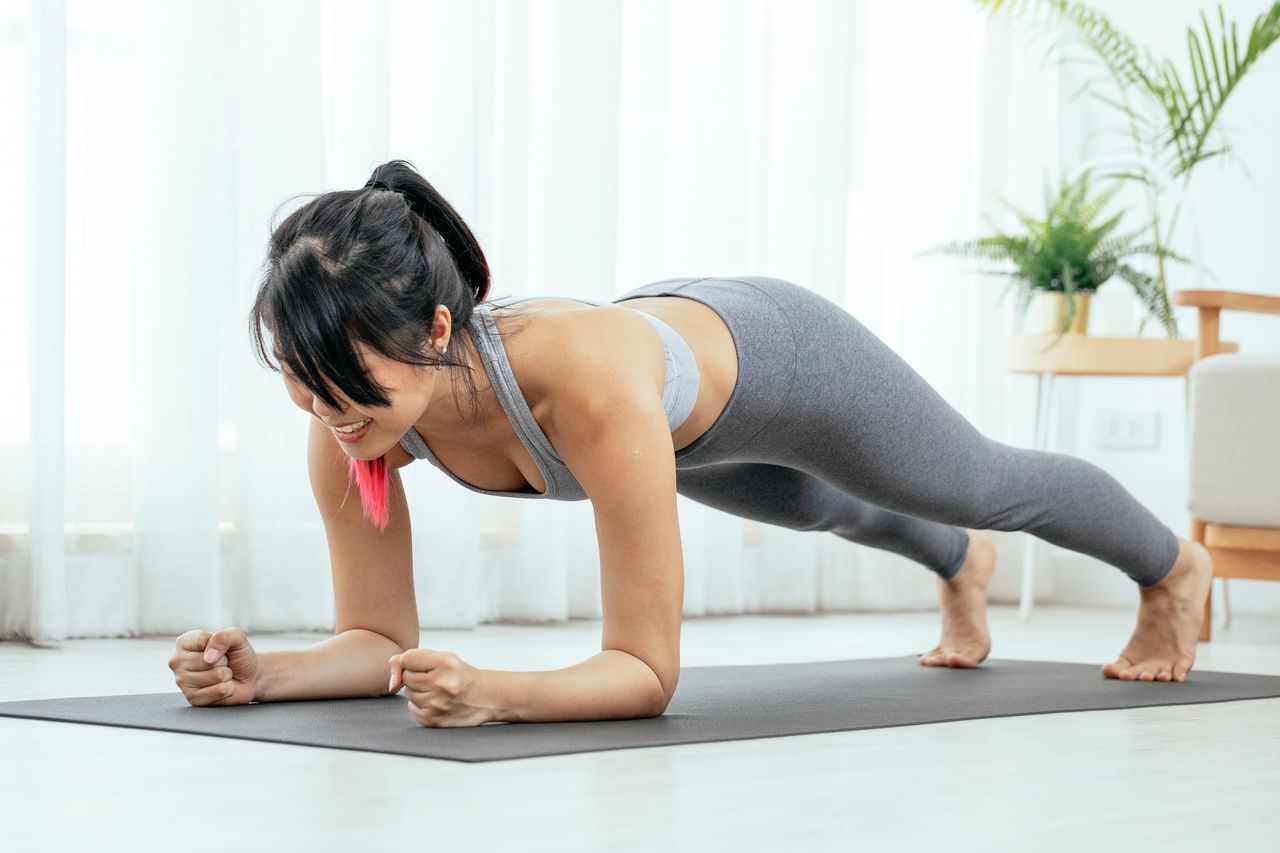
Table of contents
The clock stayed the same while the position changed
The 2014 study in Sports Biomechanics involved 19 resistance-trained men ages 18 to 35. Each performed four plank variations in a randomized order, with five minutes of rest between the 30-second holds.
The standard version placed the elbows beneath the shoulders. In the long-lever version, the elbows were roughly 6 inches apart and farther toward the head, at nose level. The researchers also tested a deliberate backward pelvic tilt, both on its own and combined with the longer lever.
Compared with the standard plank, the long-lever version produced greater activity in the upper rectus abdominis and the measured lower abdominal stabilizers. Combining the longer lever with the pelvic tilt also increased external-oblique activity. These were differences during the same length of hold.
A stronger signal is not a muscle-growth result
The researchers used surface electromyography, or EMG, to record electrical activity during the exercise. They did not put participants through a months-long training program and measure how much muscle they gained.
That distinction matters when a variation is described as more demanding. Higher activity in this test does not establish that it builds more muscle, burns more fat or produces better sports performance. The sample was also small and limited to trained young men.
Elbow placement changed in two ways: the elbows moved forward and narrowed. The experiment therefore does not tell you the separate effect of moving them forward while keeping every other part of your usual setup identical.
Treat the longer lever as a deliberate progression
For the ordinary plank, elbows below the shoulders remain the familiar starting point. Our guide to basic plank alignment explains that setup. An intentional advanced variation is a different choice from accidentally losing your original position as you tire.
In their exercise-technique article, researchers Brad Schoenfeld and Bret Contreras describe the long-lever posterior-tilt plank as an advanced option and recommend mastering basic variations first. Their advice does not make a harder variation necessary for every exerciser.
If you explore a different setup, change it between holds so you know which version you are practicing. Keep control of the position and continue breathing; Mayo Clinic’s core-exercise guidance emphasizes free, deep breathing. A painful hold is a reason to stop, rather than push for a longer lever.
When you compare plank times, compare the positions too. Thirty seconds in one setup and 30 seconds in another can represent different muscular demands, even though your timer shows the same number.