
You finish a push-up set on solid ground and look for a harder variation. Rings hang nearby; a dome-shaped balance trainer sits by the mats. Adding either changes the task. Before moving your hands onto an unstable support, decide whether you want to challenge your balance or produce a fast, powerful press.
A 2022 laboratory comparison found higher push-up speed and power with stable support than with five less stable setups. A balance challenge did not translate into a more powerful repetition.
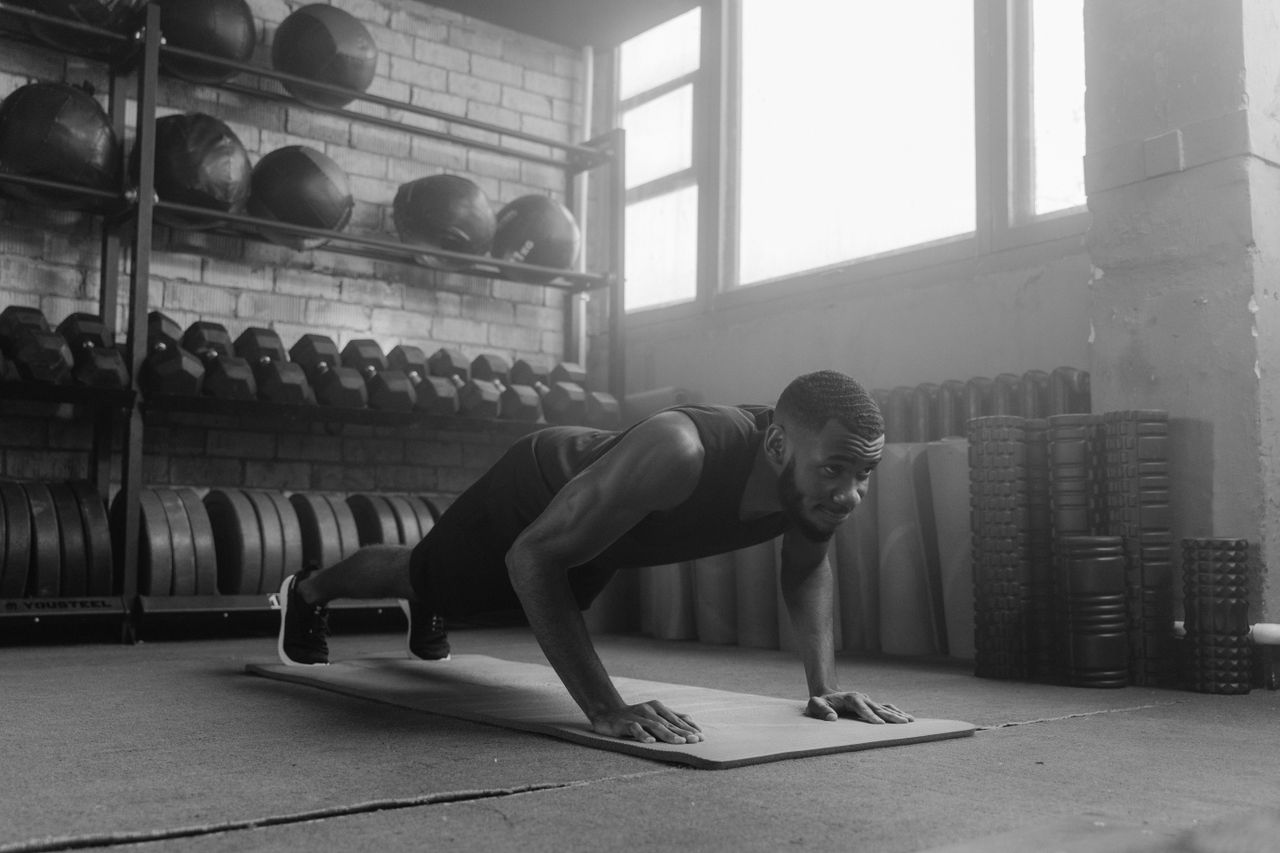
Table of contents
The stable version led a six-way comparison
The experiment involved 51 men with at least three years of strength training. Researchers separated them by experience with instability training, not by whether they were beginners at lifting.
They tested solid support, one foot lifted, rings, suspension straps, and a BOSU trainer under the hands or feet. The stable setup used a solid raised hand support. Participants performed two sets of three repetitions per condition, in random order, moving as fast as possible.
The stable condition produced the highest mean and maximum power and speed. These were measurements during testing, not results from months of training. The experiment did not measure muscle growth or include women.
A balance challenge answers a different question
That result leaves room for instability training to serve another purpose. In a 2013 Sports Health review, exercise researchers David Behm, PhD, and Juan C. Colado, PhD, explain that moderate instability can increase the demand on trunk and limb muscles while reducing the force or power produced.
They also describe training studies in recreationally active people that achieved improvements comparable to stable resistance programs. An immediate reduction in output does not establish that a method has no training value.
The useful distinction is the task you are choosing. If you deliberately want a balance or motor-control challenge, the need to steady the support may be part of the exercise. If explosive pressing is the priority, adding that challenge can interfere with the output you intended to practice. The review identifies a stable base as important for explosive power.
Keep the ordinary rep consistent first
For a standard floor version, the American Council on Exercise’s instructions place the shoulders over the hands and align the head with the spine. Brace the trunk, glutes and thighs so the body lowers and rises together.
Watch what happens between the two endpoints. The hips should not sag toward the mat or lift ahead of the chest. Press back up until the elbows straighten while keeping the torso firm. A change in body shape is another change to the repetition, separate from the surface beneath your hands.
Hand placement is a separate variable, too. Our push-up hand-width comparison examines muscle activation, rather than the power measured here. Keep the outcome attached to the comparison: an activation result cannot tell you which setup produced the fastest press.