
You pull one dumbbell out from under the couch and look for something to do besides curls. Holding it with both hands gives you a squat, a hip hinge, and two ways to work with the weight overhead. The grip and the part of your body that moves change from one exercise to the next.
Choose the load for the exercise you’re doing and check that both hands have room for a secure grip. The weight you use for squats may be too heavy to lower behind your head.
1. Goblet squat
Stand with your feet roughly hip-width apart or slightly wider. Cup one end of the dumbbell in both hands and hold it upright against your chest. In the National Academy of Sports Medicine’s goblet squat, the dumbbell stays at chest height while the hips and knees bend together. Descend as far as you can control with your feet planted, then stand.
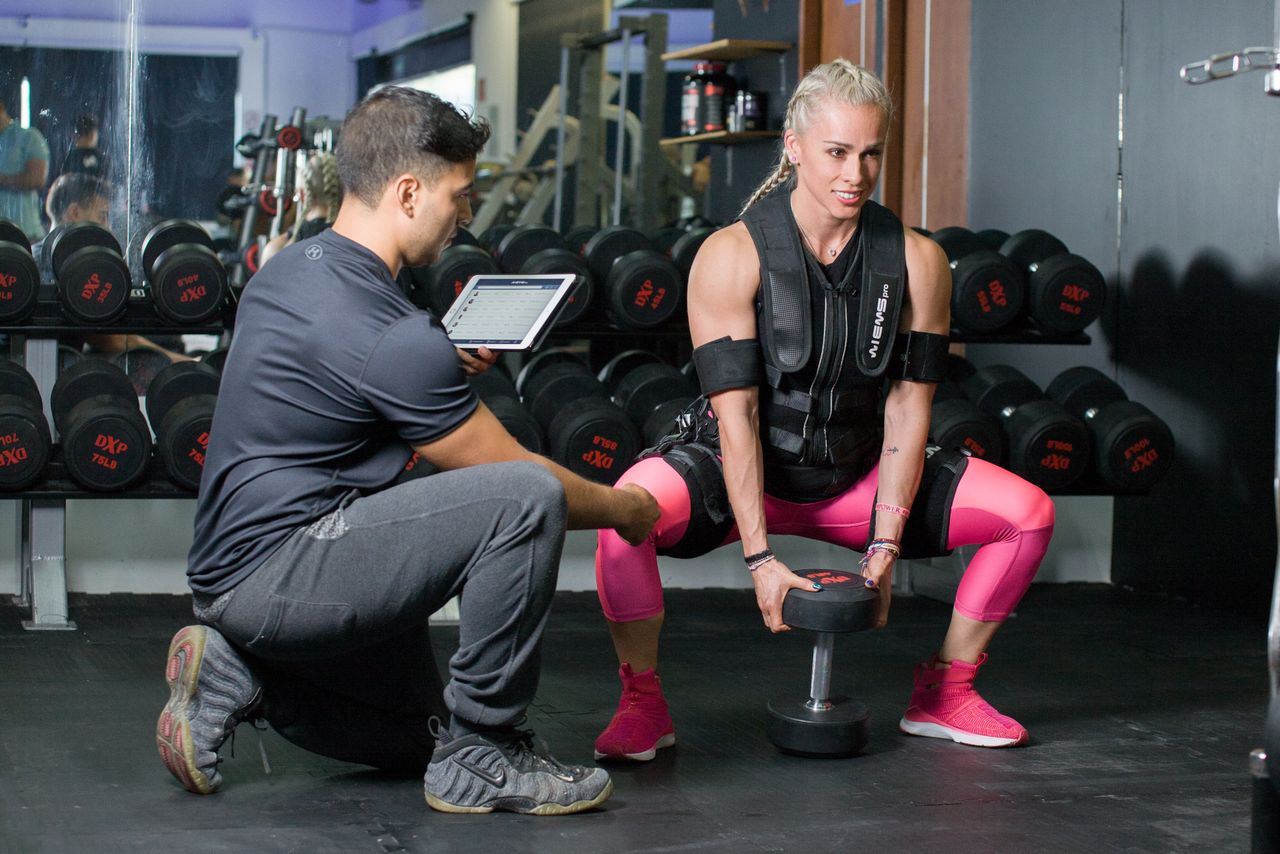
Use this one to practice a squat with the weight in front of you. If the dumbbell starts drifting away from your chest, try a lighter weight or a shallower rep. Keep the dumbbell close as you stand, especially as the last reps get harder. In the photo, the lifter uses a wider stance and holds the dumbbell low between her legs. For the goblet version, keep the weight at your chest.
2. Romanian deadlift
For the single-dumbbell Romanian deadlift, stand tall with the weight in both hands in front of your thighs. Keep a small bend in your knees and send your hips back. Let the dumbbell travel close to the front of your legs until you feel tension in the backs of your thighs. Then bring your hips forward to stand tall.
The goblet squat asks the knees to bend as you descend. Here, the initial knee bend stays roughly the same while your hips move back. Stop before the movement pulls your back out of position. Our guide to finding your Romanian deadlift depth explains why the floor is a poor target.
3. Pullover
Lie faceup on the floor with your knees bent, or lengthwise on a stable bench with your feet planted. Cup the underside of one fixed dumbbell head with both hands and bring the weight over your upper chest. As shown in the National Strength and Conditioning Association’s pullover guide, the elbows keep a small bend while the arms travel back in an arc. Pull the dumbbell forward through that same arc.
Start with a short reach and extend it only as far as you can control without lifting your ribs or arching your back farther. On the floor, the surface limits how far the dumbbell can travel. A bench leaves more room, so pick a stopping point before you lower.
4. Overhead triceps extension
Stand with one foot a little ahead of the other. Take a secure two-handed grip on the handle, then bring the dumbbell overhead. In the American Council on Exercise’s overhead extension, the upper arms stay nearly vertical while the elbows bend to lower the weight behind the head. Straighten the elbows to bring it back up.
The difference from the pullover is at the elbows. Here they bend and straighten while the upper arms stay in place. If you have to tip your torso back or swing your upper arms to finish, shorten the range or choose a lighter dumbbell.