
You get the dumbbells overhead, so the heavier pair looks like progress. But watch what happens between shoulder height and the top: your chest tips back, your ribs lift, and the curve in your lower back grows. Finishing the rep and keeping the same shoulder press are two different checks.
Before reaching for more weight, try a lighter pair and keep your torso steadier. Coaching guidance points to controlling the press, with seated support as one option. That does not mean flattening every natural curve in your back.
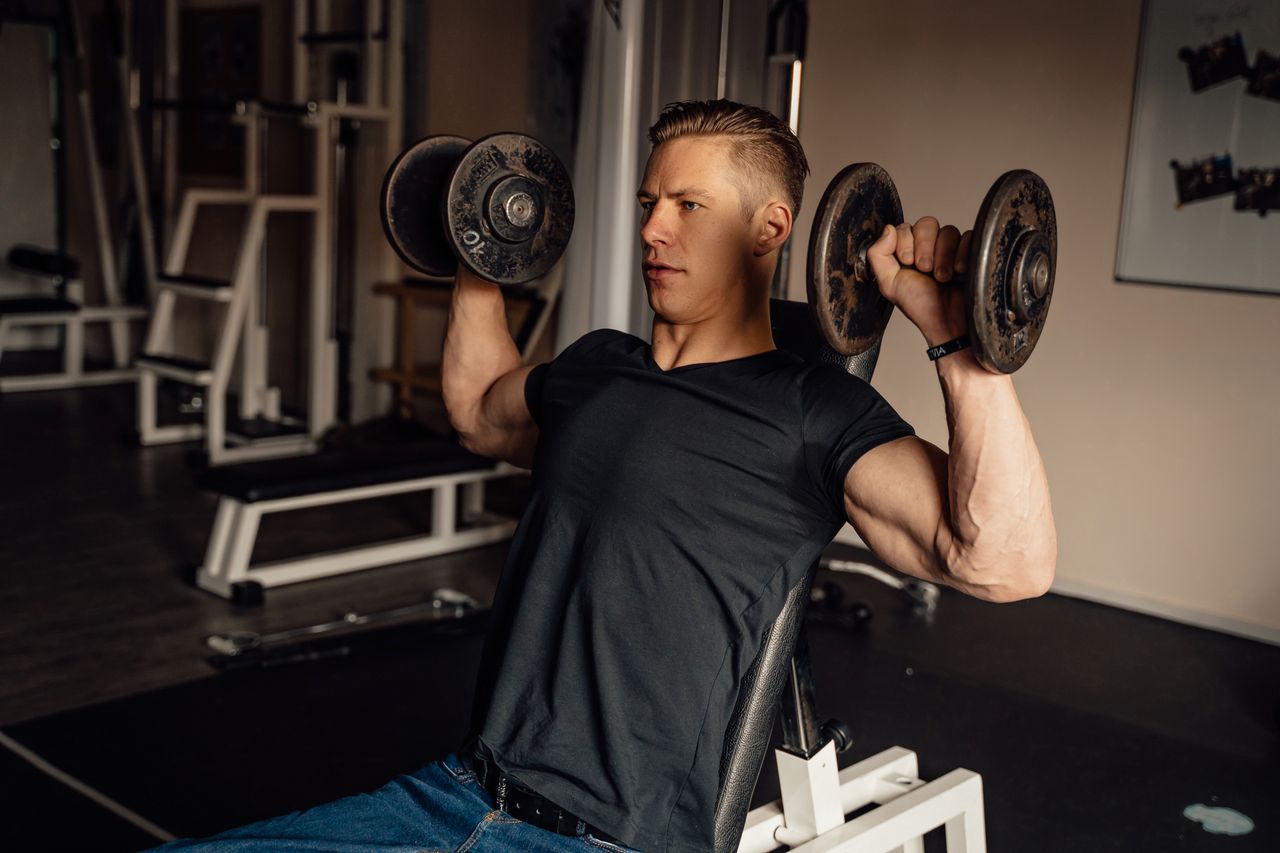
Table of contents
Watch your torso, not just the dumbbells
In a Human Kinetics book excerpt, strength coach Michael Boyle explains that leaning backward during an overhead press can turn it into something closer to an incline press, bringing the upper chest further into the movement. The weights may finish high, but the exercise has changed along the way.
The useful question is whether your torso position changes substantially as you press. A rep that starts upright and finishes with a pronounced backward lean deserves a closer look before you increase the load.
A natural lower-back curve is different from adding a bigger arch to finish. ACE’s seated machine-press instructions explicitly preserve that natural curve while advising against arching during the movement. Those instructions concern a machine, but the distinction helps explain why “keep your back steady” does not mean “force it completely flat.”
Make the next set easier to control
ACE-certified trainer Cindy Sullivan offers two ways to make a dumbbell shoulder press easier in ACE’s shoulder-training guidance: use lighter weights, or perform it seated for added stability. You can explore the movement without weights, too.
For a supported version, Nordic Fitness Education’s written instructions use an upright bench backrest, with the dumbbells beginning at shoulder level and returning there after the press. Its listed mistakes include excessive back arching. Support gives you a different setup; it does not make an uncontrolled load appropriate.
Use an easy practice set to compare your starting position with the position near the top. A trainer watching from the side can help you identify a growing backward lean that is less obvious when you are looking straight ahead. Check the lowering phase as well, rather than dropping quickly into the next rep.
Keep the movement before increasing the load
Mayo Clinic’s weight-training guidance recommends lowering the weight or repetition count when you cannot maintain good form. It also advises controlled movement instead of relying on momentum. That gives you two adjustments before trying to force another difficult press.
If your current pair allows controlled repetitions but the next pair changes your position, there may be room to build repetitions before making the dumbbell jump, within your program’s range. Keep that comparison tied to the same setup and movement, rather than counting a bigger backbend as an equivalent rep.
This check cannot tell you why overhead pressing feels difficult or diagnose a mobility limitation. If the exercise hurts, stop; do not treat leaning farther back as the solution. For your next manageable set, keep the weight where it is until the press stays controlled from the first repetition through the last.