
The taller box looks like the obvious next challenge: jump onto it, stand up and count the extra inches as progress. But clearing a higher surface involves more than lifting your body higher. How far you pull your feet upward, and the position you land in, also affect whether you make it onto the top.
That makes box height a different number from vertical-jump height. A successful landing tells you that you cleared the obstacle; by itself, it does not tell you how much higher your body traveled through the air.
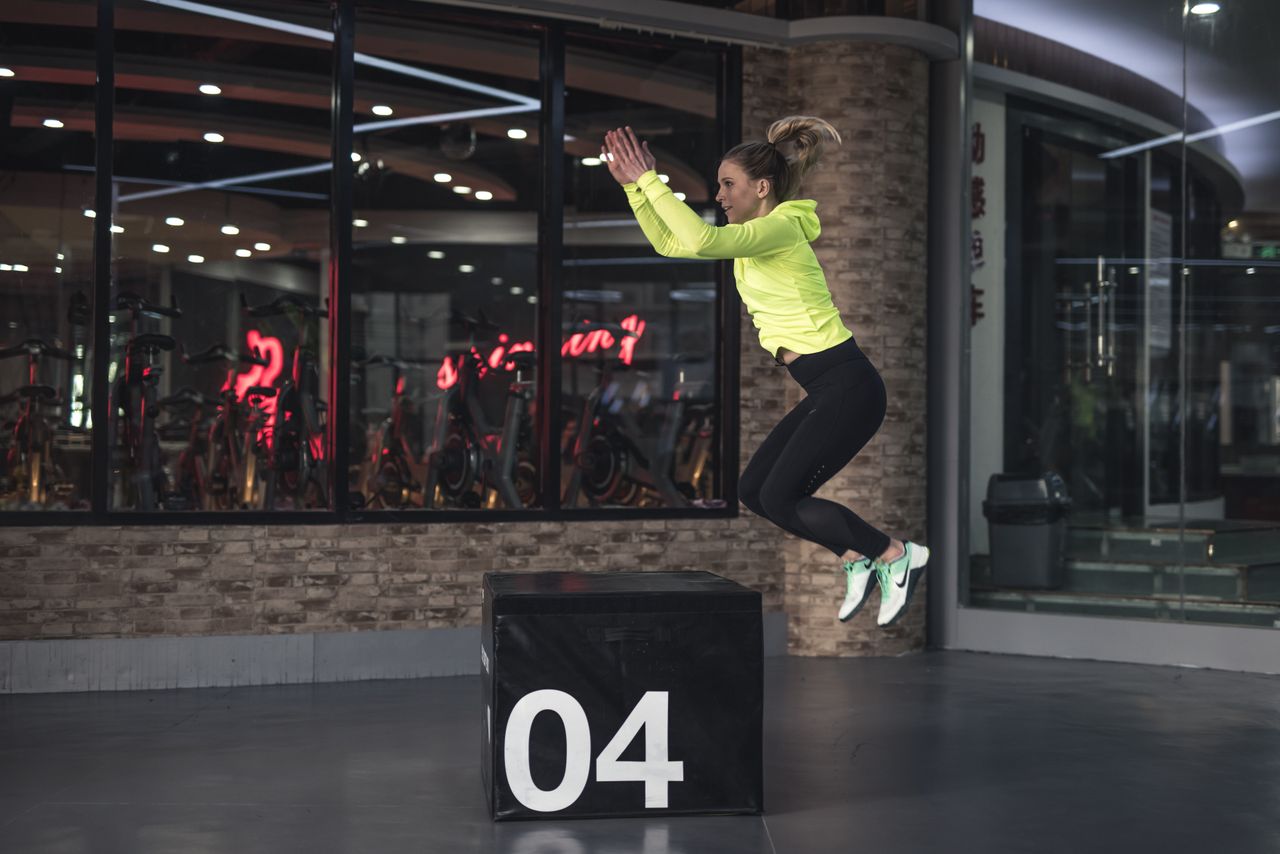
Table of contents
Two heights are hiding in one jump
The American Council on Exercise’s instructions separate the upward drive from the landing. You extend the hips, knees and ankles to launch, then bend to absorb the landing. Its listed variations include bringing the knees toward the chest, separately from raising the box.
That distinction matters when comparing attempts. Feet pulled closer to the body can clear a taller edge without the same increase in upward body travel. A deeper crouch on top also changes the position in which you finish. Box clearance combines the launch with what happens afterward.
Researchers measured the takeoff instead
In a 2024 study of 31 recreationally active college adults, researchers used force plates to calculate jump height from takeoff velocity. Participants jumped with maximal effort onto surfaces ranging from ground level to 80% of their individual maximum box-jump height.
Calculated jump height and peak power did not differ significantly across those heights. Most other measured outputs also showed no significant differences, although women produced greater peak force at the highest tested height than with no box.
The instructions prohibited knee tuck during the upward portion, and the researchers did not measure landing mechanics. This was a small, short-term comparison, not proof that every box produces identical results or that taller-box practice cannot be useful.
Choose the landing before the next number
NASM’s coaching guidance starts with a sturdy box at a height that permits a controlled landing. It calls for both feet to land on top, then a careful step down and a reset before the next repetition. A taller target that disrupts that control misses the setup requirement.
Use the landing as something to inspect, rather than treating any successful clearance as the same repetition. Can both feet arrive under control? Can you settle on top without an uneven scramble? Those questions give the height number some necessary context.
Our plyometric box exercise guide shows the basic box jump alongside other movements using the same equipment. Switching the exercise and raising the obstacle are separate choices; decide which task you are practicing before comparing scores.
If the goal is to assess vertical-jump improvement, ask your coach how that height is being measured. The distance from the floor to the box’s top cannot answer that question on its own.