
Your workout calls for chest presses, but all you have is a pair of dumbbells and some floor space. You can still do a floor press. The adjustment to notice is at the bottom: your upper arms meet the floor, creating a stopping point you don’t have when lying on a bench.
That contact changes how far you lower the weights. You don’t need to force the dumbbells toward your chest after your arms have reached the ground, and the floor version shouldn’t be treated as an identical bench press.
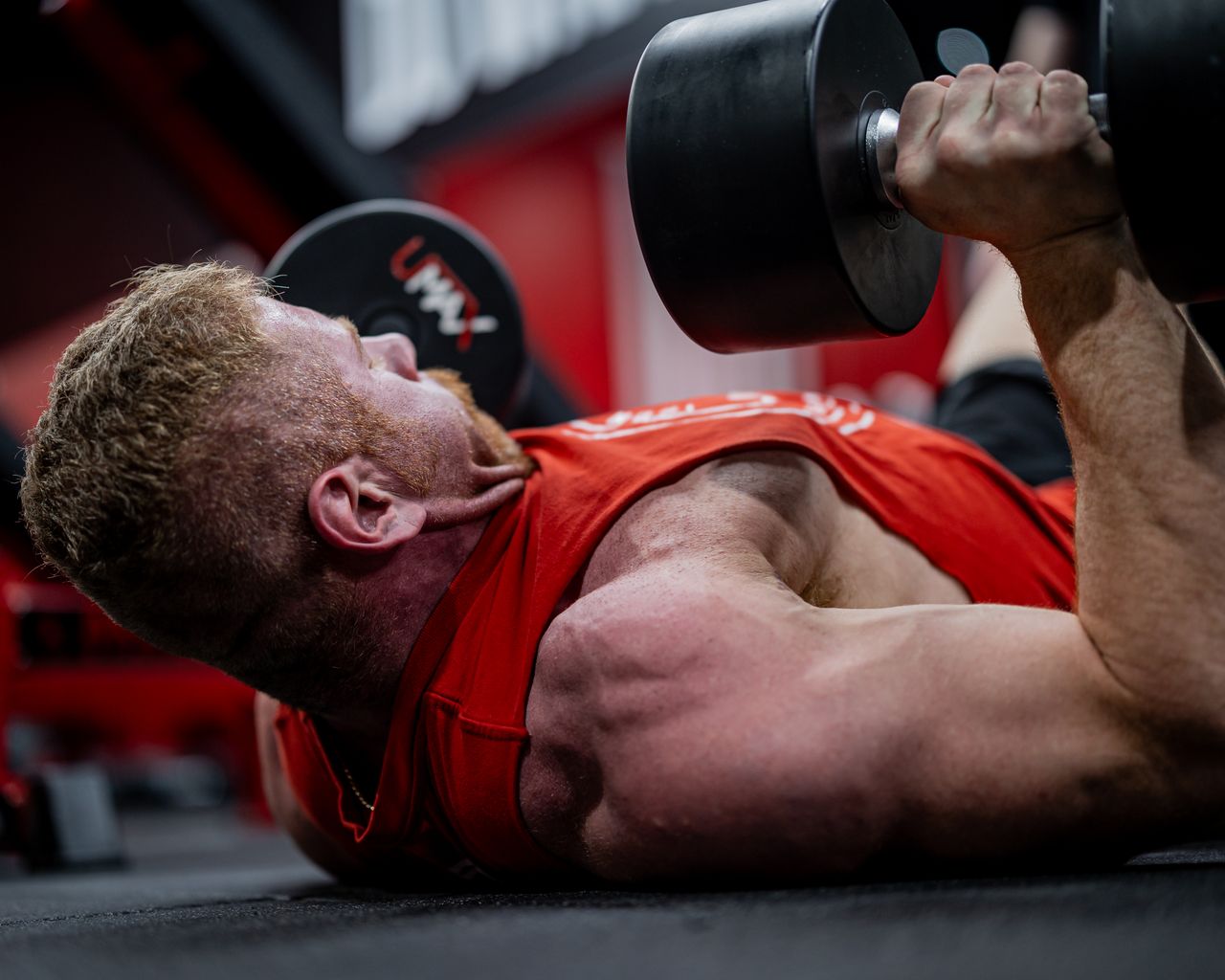
Table of contents
The surface sets the bottom position
The National Strength and Conditioning Association describes the floor as a way to limit the upper arm’s backward movement during a dumbbell press. Your torso stays on the ground, and your upper arms cannot continue traveling behind it once they meet the surface.
Compare that with the American Council on Exercise’s bench-press instructions, which describe lowering the dumbbells toward the chest. That cue belongs to its bench setup. If your upper arms reach the floor while the dumbbells are still above your chest, stop lowering there.
The difference doesn’t need a precise “half-rep” label. Your body proportions and arm position affect where the dumbbells end up. Watch the movement you can control, rather than chasing someone else’s depth or assuming every floor press covers an identical distance.
Keep it a press, with a controlled return
Mayo Clinic’s chest-press demonstration explicitly includes the floor as an alternative to a bench. Its instructions emphasize a smooth press, a relaxed, neutral head position and elbows that are almost straight at the top.
Lie on your back holding a dumbbell in each hand, with your forearms pointing upward. Press the weights above your chest, then bend your elbows to lower them under control. Keep your wrists aligned rather than letting the weights fold your hands backward.
As your upper arms reach the floor, stop lowering and reverse the movement smoothly. Lower slowly enough to avoid banging your arms against the surface. Keep your torso down rather than lifting it to change the bottom position, and don’t drive with your feet to push the weights up.
The bent elbows matter: you’re pressing the dumbbells, rather than sweeping them outward in a fly. If you’re choosing among dumbbell chest exercises without a bench, check the movement as well as the equipment. Different exercises can use the same pair of weights.
Choose a weight for this version
A shorter descent isn’t an instruction to grab heavier dumbbells. Choose a load you can handle through the setup, press and return. Mayo Clinic’s general technique guidance recommends reducing weight or repetitions when good form slips; that still applies when the floor limits your movement.
If you track your training, label these sets as floor presses. Record the weight and repetitions for that variation, then compare like with like. When a bench becomes available, reassess your load and lowering depth for that setup.