
You settle your upper arm onto a preacher pad and curl a dumbbell toward your shoulder. Across the gym, someone leans back on an incline bench to do the same basic elbow-bending movement. Both look like biceps exercises. A recent comparison shows why judging them by the biceps alone can leave part of the result out.
In a 12-week study, incline curls produced slightly greater biceps growth, while preacher curls led for two other elbow-flexor muscles. Combined growth across those three muscles did not differ statistically between the exercises.
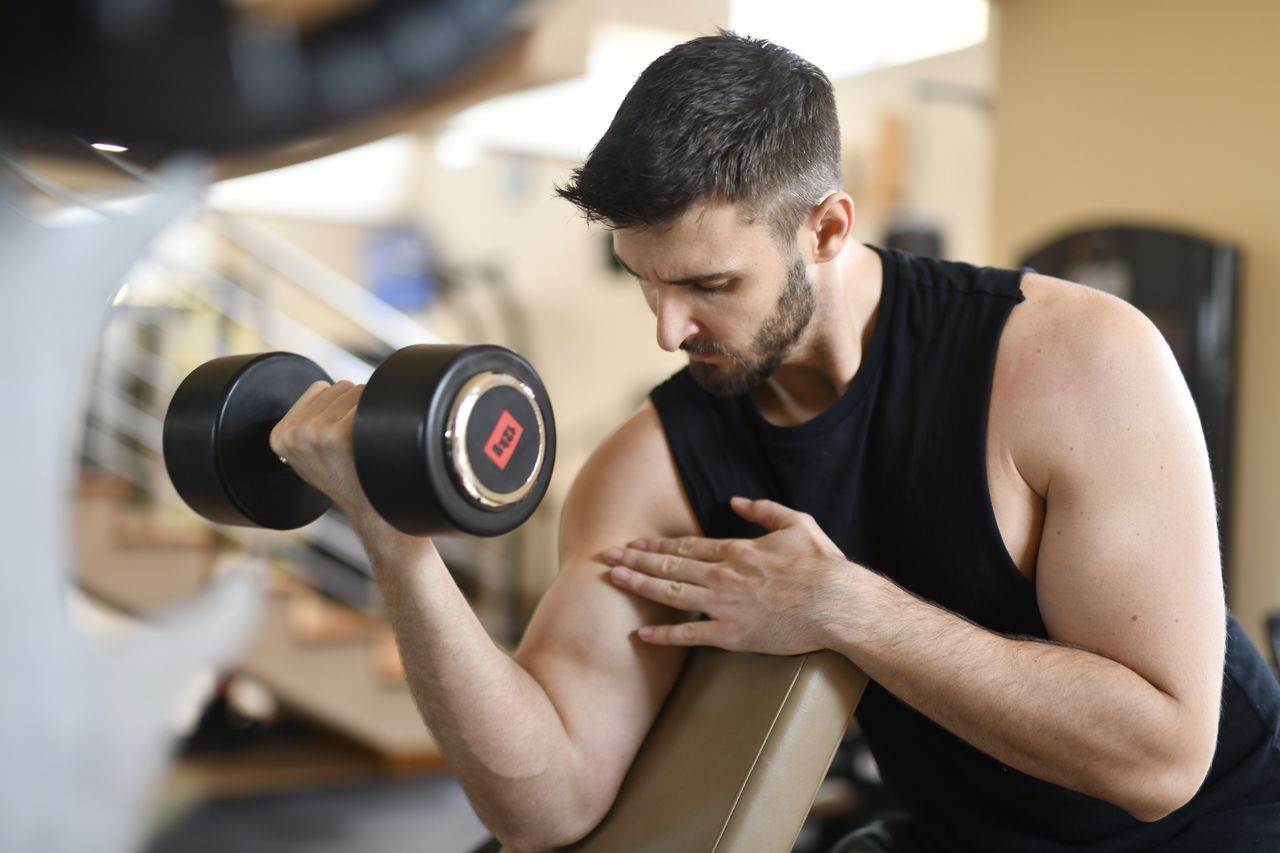
Table of contents
One person, two curl variations
The study’s public abstract, published in October 2026, reports that 21 untrained adults used one arm for incline dumbbell curls and the other for preacher curls. Each arm trained twice weekly, doing five sets of 10 repetitions at 70% of their one-repetition maximum. MRI measured changes in individual muscle volumes.
Reported biceps growth averaged 22.1% after incline curls and 18.9% after preacher curls. The direction reversed for the brachialis and brachioradialis, which grew more with preacher curls. These results come from one small novice sample, rather than establishing a settled ranking for experienced lifters.
Three muscles share the job
The biceps brachii is the familiar muscle on the front of the upper arm. But bending the elbow involves more than that one muscle. The brachialis sits deeper than the biceps, while the brachioradialis is a forearm muscle that also helps bend the elbow.
Those names matter when reading a result. “Biceps growth,” “elbow-flexor growth” and “a thicker measurement near the elbow” describe different outcomes. A chart showing one cannot automatically supply the missing measurements for the others.
An earlier trial measured a different detail
A 2025 trial offers another view of how the comparison depends on the measurement. Sixty-three untrained young women completed eight weeks of either incline or preacher dumbbell curls, twice a week. Researchers used ultrasound to measure muscle thickness at three locations along the arm.
Incline curls produced a slightly greater increase nearer the shoulder; preacher curls produced a greater increase nearer the elbow. There was no significant difference at the middle site. Those scans combined the biceps and brachialis rather than separating their contributions.
The two studies therefore describe different things: where thickness changed along the arm, and which individual muscle gained volume. A favorable result at one scan location cannot be read as proof that the entire biceps grew more.
Our preacher curl guide explains the supported setup if you are comparing it with an incline curl. The visible difference is the upper arm’s position: supported in front of the torso for the preacher version, versus hanging behind the torso when reclined on an incline bench.
For a strength comparison, keep the exercise itself consistent. In the earlier trial, each group improved more on the three-repetition maximum test for the curl it had practiced. Switching variations changes the movement you are testing as well as the number on the dumbbell.