
You slide the same plates onto the bar, finish your sets and copy last week’s weight into your workout log. But if you’ve picked up a different bar, that number may be wrong. An empty barbell isn’t automatically 45 pounds, and the difference stays in the total after you add plates.
The useful check happens before the first plate goes on: identify the bar’s weight and its unit. A 20-kilogram bar, a 15-kilogram bar and a bar actually marked 45 pounds give you different starting numbers, even when you use identical plates.
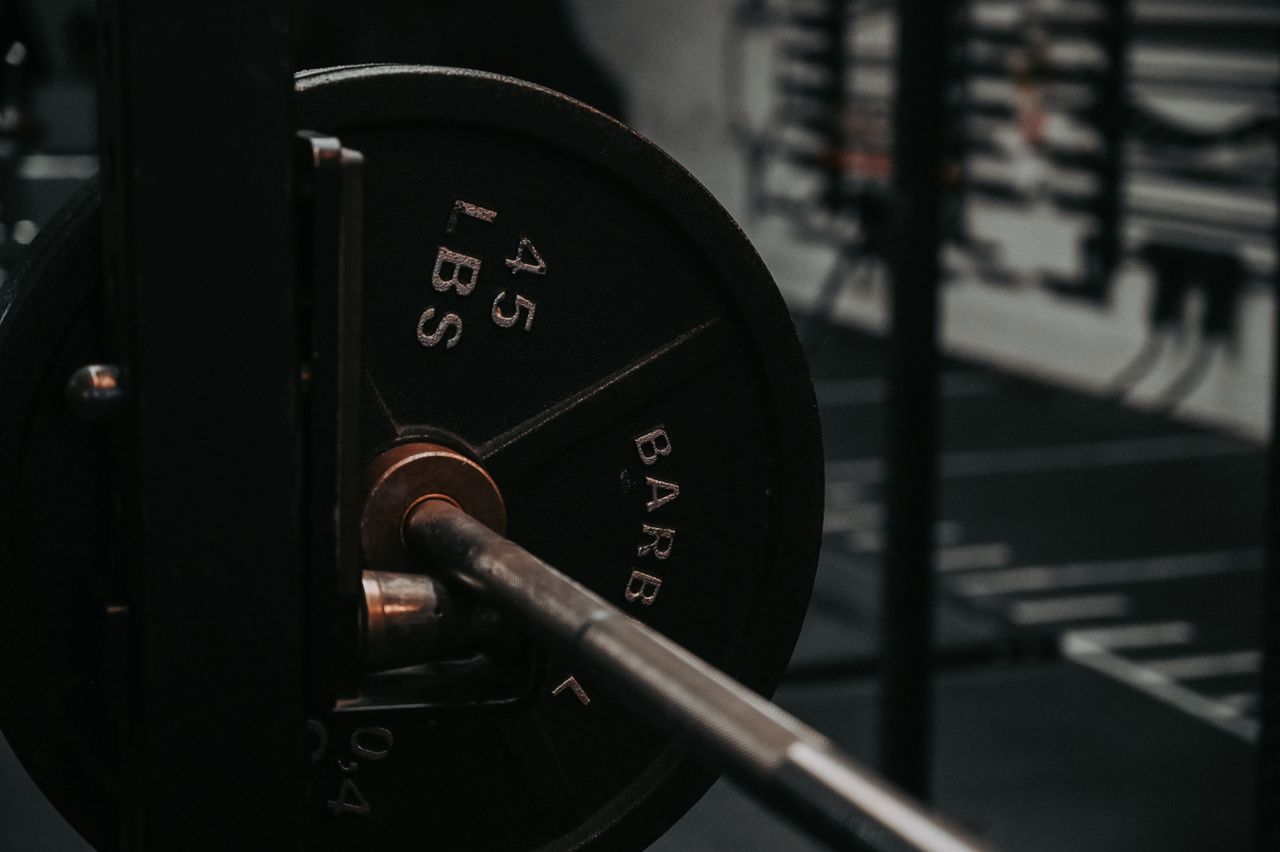
Table of contents
Close in weight doesn’t mean identical
The International Weightlifting Federation’s 2026 rules specify a 20-kilogram men’s competition bar and a 15-kilogram women’s competition bar. Those are about 44.1 and 33.1 pounds, respectively. Those labels describe competition equipment. They don’t restrict who can use those bars in ordinary gym training or state what any individual can lift.
Actual 45-pound bars exist, too: Rogue lists its 45LB Ohio Power Bar at that weight. So “45 pounds” can be the correct specification for one bar and an approximation—or a wrong assumption—for another.
A 20-kilogram bar is roughly a pound below 45. A 15-kilogram bar is roughly 12 pounds below it. Those are different-sized discrepancies, worth distinguishing before you decide that two logged sets used the same load.
The same plates can produce different totals
Take one 25-pound plate on each side. Using the marked weights, and leaving collars out of this comparison:
- A 45-pound bar gives you 95 pounds.
- A 20-kilogram bar gives you about 94.1 pounds.
- A 15-kilogram bar gives you about 83.1 pounds.
If you entered 95 pounds for the last example, you’d be recording nearly 12 pounds more than the bar and plates add up to. Adding another 5-pound plate to each side would increase that setup by 10 pounds; it wouldn’t correct the original entry.
The reverse matters when you switch bars: moving those plates from a 15-kilogram bar to a 45-pound bar increases the total even though you haven’t added a plate. Check the arithmetic before interpreting the change as a change in your performance.
Find the specification, then record the setup
Look for a weight or model marking on the bar or its end cap. If it isn’t clear, ask gym staff to identify it rather than judging by appearance. Our guide to barbell weights explains the broader variations; the number for the specific bar in your hands is what belongs in your calculation.
Technique bars can be lighter still. For example, Rogue’s T-15LB Technique Bar weighs 15 pounds and has its own stated loading limit. Recognizing a familiar bar shape doesn’t establish either its empty weight or how it may be loaded.
Keep the bar and plates in one unit when adding them. Convert the bar’s kilograms to pounds if your plates and log use pounds, rather than adding a bare “15” to a pounds-based total.
For collars, record their known weight if you’re recording the complete loaded total. Don’t assume ordinary gym collars weigh the same as IWF competition collars, which the rules specify at 2.5 kilograms each.
A brief note such as “15-kg bar, 25 lb per side” preserves the setup behind your total. It also gives you something to check when a different bar is the only one available next time.