
You buy a tub of creatine, then notice that the suggested first week involves several servings a day. Suddenly a simple supplement looks like a schedule. That initial loading phase has a purpose, but it is not an entry requirement. For healthy adults who decide to use creatine, the main trade-off is how quickly muscle stores increase.
A lower daily dose can raise those stores gradually. The Australian Institute of Sport describes 3 to 5 grams of creatine monohydrate daily as an alternative to loading, with muscle saturation taking about four weeks. Loading reaches that point sooner.
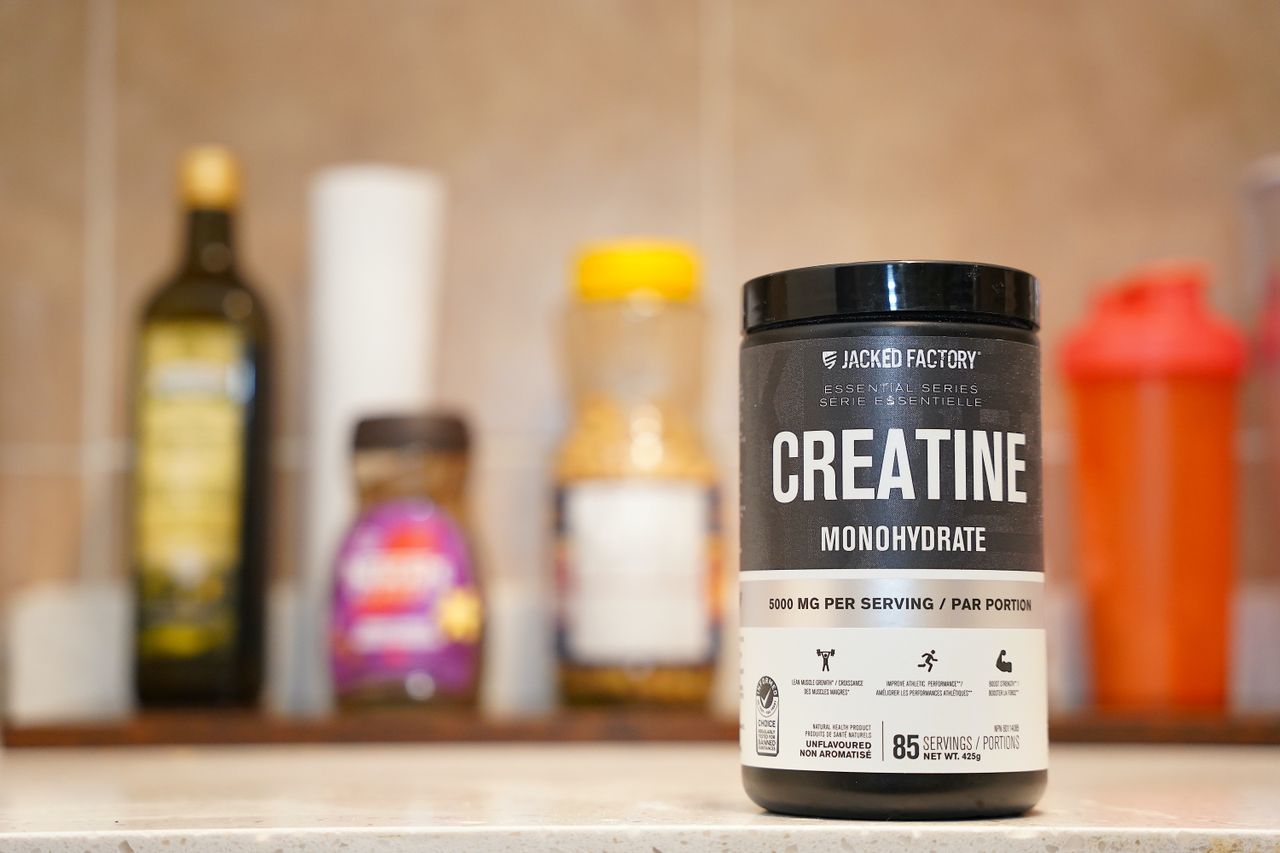
Table of contents
Loading changes the timeline
A widely used loading protocol is about 20 grams a day, split into four 5-gram servings, for five to seven days. A lower maintenance dose follows. The NIH Office of Dietary Supplements also describes a lower-dose approach over several weeks without that initial high-dose phase.
The classic comparison comes from a 1996 paper involving 31 healthy men across several experiments. Researchers observed an approximately 20% rise in muscle creatine after six days at 20 grams daily. Taking 3 grams daily produced a similar average increase over 28 days.
The volunteers were not highly trained, and this was a study of creatine accumulation. That result cannot be translated into a promise that the two approaches produce identical strength gains or a particular amount of muscle growth.
A faster rise in stores is not a faster physique transformation
Creatine helps support the rapid supply of energy used during repeated, intense efforts. That is why it is relevant to lifting and sprinting. It is also why a loading phase can interest an athlete who wants elevated stores sooner, while someone starting a long training block may have less reason to rush.
A 2021 scientific review of creatine misconceptions identifies both loading and lower daily dosing as established approaches. The choice changes the buildup period; it does not replace the training stimulus needed to improve performance and build muscle.
Keep the outcome you care about clear. Improving a lift and increasing muscle size overlap, but they are separate training goals, as our guide to hypertrophy versus strength explains. Reaching a higher muscle creatine concentration is another measurement again.
The first week’s scale change can be misleading
The scale can rise as muscle creatine and body water increase. The AIS notes that this can matter for athletes who must make a weight class. An early increase in body weight does not, by itself, show that you have built new muscle tissue.
Some people also experience stomach upset. Avoiding the loading phase and using a lower daily dose is one option the AIS describes for reducing that problem. More powder at once is not a shortcut: the familiar loading approach divides the total across the day.
These protocols concern creatine monohydrate, the form with the most extensive research. A premium price or a different form does not establish better results. If you have kidney disease or are pregnant or breastfeeding, ask your clinician before use. A general sports protocol is not a personal prescription.
For an otherwise healthy adult choosing the slower approach, the expectation is straightforward: allow several weeks for muscle stores to build. Skipping loading means accepting that wait, not having to restart because the first week lacked multiple servings.